11.17.2551

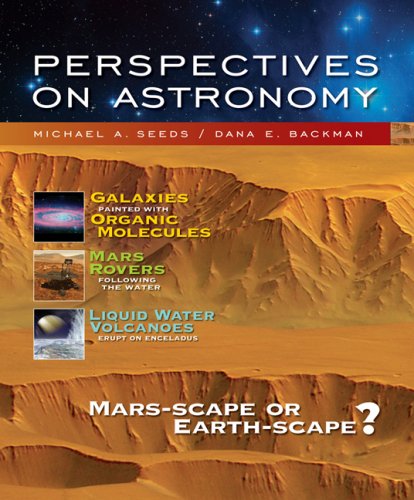
Perspectives on Astronomy, Media Edition (with CengageNOW, Virtual Astronomy Labs Printed Access Card) By Michael A. Seeds, Dana E. Backman

Authors Mike Seeds and Dana Backman personalize the history of the universe by placing you at the center of the latest chapter in a grand and amazing story. You will learn how we are the latest link in the "great chain of origins." And, by emphasizing the role of the scientific process, Seeds and Backman will help you also understand how analyzing scientific evidence not only answers the question "How do we know?," but provide deeper insights into our place in the universe as well. Each new copy of the text comes with access to CengageNOW, an online personalized learning system designed to save you time in studying and to help you prepare for exams through a series of diagnostic tests and personalized study plans.

Customer Reviews

  • enjoyable and authoritative read4
    If you are curious about our universe, this book is an enjoyable and reliable introduction. The authors are professional astronomers, who write eloquently for a general, educated audience. In straightforward prose, they describe the reaches of modern astronomy.
    Including the marvellous results of spacecrafts that have been to other planets in our solar system. The photos of planetary surfaces are beautiful and illuminate much information about our nearest neighbours.
    On a different scale, literally, is the evolution of the universe itself. From the Big Bang and the Cosmic Microwave Background to the condensation of the galaxies and their stars. And the evolution of the elements, starting from hydrogen. A conceptual sweep.

Source from astronomy-cheap-books-20

11.11.2551

Photoshop Elements 7: The Missing Manual By Barbara Brundage

Amazon.com Review

Photoshop Elements 7 includes new tools for everything from fixing up your photos to storing and sharing your pictures online. There's so much to this new version, in fact, that knowing how to make the most of it isn't readily apparent. Photoshop Elements 7: The Missing Manual guides you through all of the program's features by explaining the way the tools and commands work, and how you can use them to your advantage.

Sneak Preview: Author Barbara Brundage’s Top 10 Elements Tips

Author Barbara Brundage

1. It's still important to back up your photos. Elements 7 gives you a totally painless way with its related web site. Sign up for a free account and you can set your albums to automatically back themselves up to your space online. Once you set up album syncing, you don't have to think about it again. It happens automatically. If you have a computer disaster at home, just reinstall Elements on the new computer, turn on the backup/sync option, and sign in to the site, and your photos reappear on your new computer. This service has some limitations (all detailed in the book), but it's a terrific way to keep an extra copy of important photos. And you still have the regular Organizer options for backing up to CD, DVD, or a different hard drive.

2. Find a size that fits. If you've been using Elements for scrapbooking, take a look at the new file size presets available in Elements 7. There's a whole separate category for scrapbook sizes in the New File dialog box. Now you can create a 12"-, 8"-, or 6"-square sized file without having to set up a custom size.

3. On vacation? Take a private tour. If your “staycation” this year takes you to a nearby tourist spot along with everyone else in your state, you can get rid of those strangers crowding into your photos—as long as you plan ahead a little. Start by getting a series of pictures that give you enough clear spots, even if there are people you don't know meandering somewhere through every photo. Then you can combine the pictures with the Elements 7 Scene Cleaner to create an image of Aunt Esmeralda and Cousin Wilberforce standing in front of the falls all by themselves, with nobody else around.

4. Make slideshows like a pro. With Elements 7 you can share your albums with dynamite, professional-looking galleries. Create a gallery where your photos appear as a pile of old-fashioned slides. Your friends can then sort through, and click the ones they like, to see a larger view. Elements has other gallery options that let you create a virtual book where your visitors "turn" the page with the mouse. And you can host these at the related web site, burn them to a CD or DVD, or even post them on your own web site.

5. Create beautiful skin. If you like glamour-type photography, check out the new Surface blur filter to create dreamy looking skin quality. It blurs without losing edge detail: perfect for smoothing skin in portraits.

6. Make dramatic skies. If you're a beginner, try the new Quick Fix/Touch Up tool for making the sky bluer--maybe too blue (and kind of green) if truth be told. Fortunately, you can soften up the effect once you're done. Go back to Full Edit and find the Layers palette (you don't need to understand layers for this maneuver). Click once on the layer that Elements just added to your photo (it's called Blue Skies), and then go up to the top of the palette and move the opacity slider to the left. Watch your photo as you move the slider. When it looks real, you're done. (Click the bottom layer, the one called Background, before you leave the Layers palette. That way you can make more edits to your photos.) Another option: You may prefer the results you get using the Smart Brush in Full Edit, if your sky has any clouds in it. In the tool presets in the Options bar, go to Nature->Cloud Contrast and drag across the sky. Presto, your clouds really stand out!

7. Never, ever work on your original photo. If you use the Organizer, good news: Elements already has your back. It creates version sets, which save different states of your image as you edit. You can create as many different versions of a photo as you like and go back to any one of them at any time. And if you’re working with Raw files, even better news: You can't alter your original (only the conversion settings). If you don't use the Organizer, make a copy of the picture (File- >Duplicate) and work on that. This way you can always start over again if you get a better idea later on.

8. Sharing photos with the Organizer. There are all kinds of fun, creative ways to share photos in Elements 7, and the Organizer makes it super easy to explore them all. Try a slideshow with music and commentary, or upload your photos to EasyShare or one of the other online services to create mugs, bags, and other cool gift items with your photos on them.

9. Don't scorn the auto buttons. If you've never tried these one-click fixes--Auto Levels or Auto Color, for example--give ‘em a try. Each version of Elements gets a little smarter and you may find that you like the results you get from one of these easy-to-use fixes.

10. Panoramas for everyone. You don't need to feel wistful anymore about the fact that your point and shoot camera's lens doesn't have a true wide-angle setting. Take a series of photos with, ideally, about a 30 percent overlap and Elements' Photomerge will automatically stitch them together into a panorama wider than you could have captured with the widest lens. Photomerge is really amazing--it’s totally automated and it does terrific blending to eliminate visible seams between images.

Look Inside Photoshop Elements 7: The Missing Manual
Click thumbnails to open full-size images in a new window.

Photoshop Elements 7, page 112
Photoshop Elements 7, page 258
Photoshop Elements 7, page 375

Source from digital-photography-textbooks-20
11.07.2551

The Fabric of the Cosmos: Space, Time, and the Texture of Reality By Brian Greene

From Brian Greene, one of the world’s leading physicists and author the Pulitzer Prize finalist The Elegant Universe, comes a grand tour of the universe that makes us look at reality in a completely different way.
Space and time form the very fabric of the cosmos. Yet they remain among the most mysterious of concepts. Is space an entity? Why does time have a direction? Could the universe exist without space and time? Can we travel to the past? From Newton’s unchanging realm in which space and time are absolute, to Einstein’s fluid conception of spacetime, to quantum mechanics’ entangled arena where vastly distant objects can instantaneously coordinate their behavior, Greene takes us all, regardless of our scientific backgrounds, on an irresistible and revelatory journey to the new layers of reality that modern physics has discovered lying just beneath the surface of our everyday world.

  • Amazon Sales Rank: #3941 in Books
  • Published on: 2005-02-08
  • Released on: 2005-02-08
  • Original language: English
  • Number of items: 1
  • Binding: Paperback
  • 592 pages

Fascinating5
How these scientists even conceived of the ideas about the cosmos is beyond me. Greene does an excellent job of walking the non-physicist reader through concepts that may otherwise be inaccessible.

Wonderous5
I am a layman who has been curious about the concept of Sting Theory for some time. I found Greene's book a window into the soul of the universe. He has helped me comprehend (to my limits) the fabric of the cosmos. I echo the other rave reviews and will go back to this book time and time again.

GREENE GREAT, AMAZON WEBMASTER SUCKS5
How awful. I wrote a long and interesting review of Greene's book. But then I had to go to another page to fill out your Tag idea, and when I came back the review had vanished. No, I'm not going to write it again; the designers of this web page ought to write it themselves if they can write.

Source from astronomy-cheap-books-20

11.05.2551

The Adobe Photoshop Lightroom 2 Book for Digital Photographers (Voices That Matter) By Scott Kelby

Written in concert with Adobe's development of the Photoshop Lightroom 2 Beta, The Adobe Photoshop Lightroom 2 Book for Digital Photographers - by #1 bestselling computer and technology author, Scott Kelby - is the most complete and concise Lightroom "how-to" book for digital photographers of all skill levels.


In The Adobe Photoshop Lightroom 2 Book for Digital Photographers, Scott walks readers through the basics of Lightroom use, leading them to a brilliantly devised and super efficient digital photography workflow that dramatically improves productivity and allows photographers to spend less time processing photos and more time shooting them.


Throughout the book Scott shares his personal camera and Lightroom settings, as well as the studio-tested techniques he's developed for his own photography workflow. The book is written in his trademark step-by-step, plain English style, and because he knows what really works and what doesn't, he isn't shy to tell you flat out which tools to use, which to avoid, and why. This allows digital photographers of any skill level to jump right in using Lightroom like a pro from the very start, sidestepping a lot of the frustrations that typically haunt those unfamiliar with new applications…especially those as powerful as Lightroom.


What really sets The Adobe Photoshop Lightroom 2 Book for Digital Photographers apart from other Lightroom books on the market are the last two bonus chapters where Scott answers the questions, "In exactly what order am I supposed to do things in Lightoom," and "Where does Photoshop fit in to the mix?" Both chapters start with an on-location photo shoot, including full details on the equipment, camera settings, and lighting techniques. Readers then witness as he takes the photos from each shoot through the entire workflow process, to the final output of the 16"x20" prints. And, because he incorporates Photoshop seamlessly right into this workflow, you'll learn some of the latest Photoshop techniques for portrait and landscape photography as well.


If you're one of those people who learns best by actually doing the projects yourself; who learns best without all the complicated technical explanations and confusing jargon, and if you really want to start using Lightroom today to unlock the productivity secrets of "The new digital photography workflow,"---there is no faster, more "straight-to-the-point" or more fun way to learn than this groundbreaking new book, and you are absolutely going to love it!

Source from digital-photography-textbooks-sales-20

11.04.2551

Earth: Portrait of a Planet, Second Edition By Stephen Marshak

This new edition retains the engaging style, clarity of explanations and accuracy of the science praised in the first edition. New case studies focus on how humans interact with the geology around them, both positively and negatively; and relevant material is included on comparative planetary science, highlighted by the success of the 2004 Mars missions.

  • very good5
    The book was sent to me in about 2 weeks, and it was in the exact condition they said it would be.
  • About the book4
    The book is in good condition but the shipping is too bad. O have to wait 2 weeks for it
  • The best of geology5
    This book is indeed the best introduction to geology you can ever get. It has the most fundamental knowlegde and at the same time it includes a higher level. So it is for all people with an interest in geology. If you are a student and even if you are a normal person with great interest this book will become your favorite. It combins beautyful pictures with nice drawings and great text. It gives a good picture of what it is like to be a geologist and what the work includes.
    Simply: you get the best of geology!! Injoy:o)

Source from astronomy-cheap-books-20

11.03.2551

A Briefer History of Time By Stephen Hawking, Leonard Mlodinow

Stephen Hawking’s worldwide bestseller, A Brief History of Time, has been a landmark volume in scientific writing. Its author’s engaging voice is one reason, and the compelling subjects he addresses is another: the nature of space and time, the role of God in creation, the history and future of the universe. But it is also true that in the years since its publication, readers have repeatedly told Professor Hawking of their great difficulty in understanding some of the book’s most important concepts.
This is the origin of and the reason for A Briefer History of Time: its author’s wish to make its content more accessible to readers—as well as to bring it up-to-date with the latest scientific observations and findings.
Although this book is literally somewhat “briefer,” it actually expands on the great subjects of the original. Purely technical concepts, such as the mathematics of chaotic boundary conditions, are gone. Conversely, subjects of wide interest that were difficult to follow because they were interspersed throughout the book have now been given entire chapters of their own, including relativity, curved space, and quantum theory.
This reorganization has allowed the authors to expand areas of special interest and recent progress, from the latest developments in string theory to exciting developments in the search for a complete unified theory of all the forces of physics. Like prior editions of the book—but even more so—A Briefer History of Time will guide nonscientists everywhere in the ongoing search for the tantalizing secrets at the heart of time and space.

Source from astronomy-cheap-books-20

11.02.2551

The Digital Photography Book, Volume 2 By Scott Kelby


Scott Kelby, author of the groundbreaking bestseller “The Digital Photography Book, Vol. 1” is back with an entirely new book that picks up right where Vol. 1 left off. It’s more of that “Ah ha—so that’s how they do it,” straight-to-the-point, skip the techno jargon; packed with stuff you can really use today, that made Vol. 1 the world’s bestselling book on digital photography.
In Volume 2, Scott adds entirely new chapters packed with Plain English tips on using flash, shooting close up photography, travel photography, shooting people, and even how to build a studio from scratch, where he demystifies the process so anyone can start taking pro-quality portraits today! Plus, he's got full chapters on his most requested topics, including loads of tips for landscape photographers, wedding photographers, and there's an entire chapter devoted to sharing some of the pro's secrets for making your photos look more professional, no matter what you're shooting.
This book truly has a brilliant premise, and here’s how Scott describes it: “If you and I were out on a shoot, and you asked me, ‘When I use my flash, the background behind the person I’m shooting turns black. How do I fix that?’ I wouldn’t give you a lecture on flash ratios, or start a discussion on flash synchronization and rear curtain sync. I’d just say “Lower your shutter speed to 1/60 of a second. That should do it” Well, that’s what this book is all about: you and I out shooting where I answer questions, give you advice, and share the secrets I’ve learned just like I would with a friend—without all the technical explanations and techie photo speak.”
Each page covers a single concept on how to make your photography better. Every time you turn the page, you’ll learn another pro setting, tool, or trick to transform your work from snapshots into gallery prints. If you’re tired of taking shots that look “okay,” and if you’re tired of looking in photography magazines and thinking, “Why don’t my shots look like that?” then this is the book for you.
This isn’t a book of theory—full of confusing jargon and detailed concepts. This is a book on which button to push, which setting to use, and when to use it. With nearly another 200 of the most closely guarded photographic “tricks of the trade,” this book gets you shooting dramatically better-looking, sharper, more colorful, more professional-looking photos every time.

source from digital-photography-textbooks-sales-20

 
Template by suckmylolly.com